If you watch Hollywood movies, you know that in Western culture, expressing love is loud, direct, and frequent. Parents tell their kids “I love you” every night before bed. Couples say it multiple times a day. Affection is spoken out loud.
So, when a Westerner interacts with a Chinese family, or dates a Chinese person, they often get confused. They might ask themselves: “Why don’t they ever say ‘I love you’? Do they actually care about me?”
The answer is a resounding yes. Chinese people feel love just as deeply as anyone else, but their culture expresses affection in a completely different way. In China, love is rarely a spoken language. It is a language of actions, sacrifice, and—often—food.
Here is a deep dive into the unique ways Chinese culture expresses love and affection.
1. The Language of Food and Nurturing
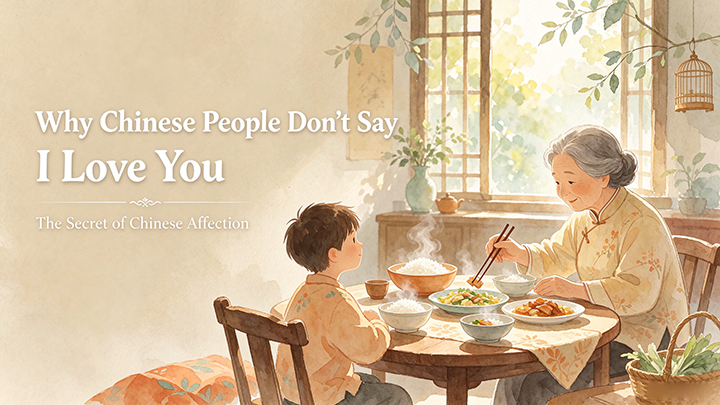
In Chinese culture, the most common way to say “I love you” is by making sure you are well-fed.
If you visit a Chinese home, the host or a parent will constantly push food onto your plate. They will ask, “Have you eaten yet? (你吃了吗?)” not just as a greeting, but as a genuine expression of care. When a Chinese mother spends hours cooking a complex soup for you because she heard you were feeling tired, that is her way of saying: I love you.
The act of ensuring someone is warm and fed is the ultimate form of nurturing in Chinese families.
2. “Have You Eaten Yet?” Instead of “How Are You?”
Even among friends, affection is shown through practical care. While a Western friend might say, “Let me know if you need to talk,” a Chinese friend might say, “Let’s go grab some hot pot.”
They want to do something for you rather than just sit and talk about feelings. If you are sick, a Chinese partner won’t just say “I hope you feel better.” They will bring you hot water, buy you medicine, and perhaps make you a bowl of congee (rice porridge).
3. The Concept of “Tacit Understanding” (Moqi – 默契)
In Western relationships, open communication is often seen as the most important pillar. In Chinese culture, there is a huge emphasis on Moqi (默契), which translates to a tacit understanding or unspoken chemistry.
True affection is proven when you don’t have to say what you need—the other person just knows. For example, a husband might silently hand his wife a hair tie or hold her bag without being asked. A mother might buy the exact snack her child was craving without the child ever mentioning it.
For Chinese people, needing to constantly say “I love you” can sometimes feel superficial or unnecessary if the actions aren’t there.
4. Showing Love Through Sacrifice
This is especially true for Chinese parents. The concept of “face” (Mianzi) and family duty often means parents will sacrifice their own comfort—working long hours, saving every penny—to ensure their children have a better life.
They might never say “I am so proud of you” or “I love you,” but the brand-new laptop they bought for your college education speaks louder than any words. This tough, silent love can sometimes feel cold to Westerners, but it comes from a place of immense devotion.
5. How to Navigate This Cultural Difference
If you are dating a Chinese person or have Chinese in-laws, this cultural gap can cause misunderstandings.
- Don’t confuse silence with apathy: If they don’t say “I love you” every day, it doesn’t mean they don’t care. Look at what they do.
- Understand the boundaries: Chinese people might ask very personal questions (like how much rent you pay or when you plan to get married) very early in the relationship. This isn’t meant to be nosy; in Chinese culture, this level of inquiry signals intimacy and concern for your well-being.
- Communicate your own needs: If you are a Westerner who needs to hear the words, it’s okay to tell your Chinese partner: “In my culture, saying ‘I love you’ is very important to us.” Most Chinese people are happy to adapt once they understand it’s a genuine need.
Final Thoughts
Love in China is a quiet force. It is woven into the 10-course dinner prepared for a family gathering, the oversized winter coat a grandmother forces you to wear, and the unspoken support when you are going through a hard time.
While the Western way of saying “I love you” is beautiful and straightforward, the Chinese way—subtle, practical, and deeply rooted in action—is equally profound.
The next time you wonder if someone cares, just look at who is making sure your bowl of rice is never empty.