If you want to understand modern Chinese everyday life, you shouldn’t look at the towering skyscrapers or high-speed trains. Instead, you need to wake up early and step into a Chinese Wet Market (Cài Shì Chǎng – 菜市场).
For Westerners, grocery shopping often means driving to a massive, sterile supermarket once a week and buying pre-packaged food. But in China, the wet market is a daily ritual. It is loud, incredibly vibrant, slightly messy, and it is the beating heart of the local community.
Here is a fascinating look inside the Chinese wet market, and why it remains an essential part of daily life.
1. Why is it Called a “Wet” Market?
The term “wet market” comes from the traditional practice of keeping the floors wet to preserve freshness. But today, it simply refers to a market that sells fresh, unprocessed food—meat, seafood, vegetables, and fruits—compared to the dry, packaged goods you find in a supermarket.
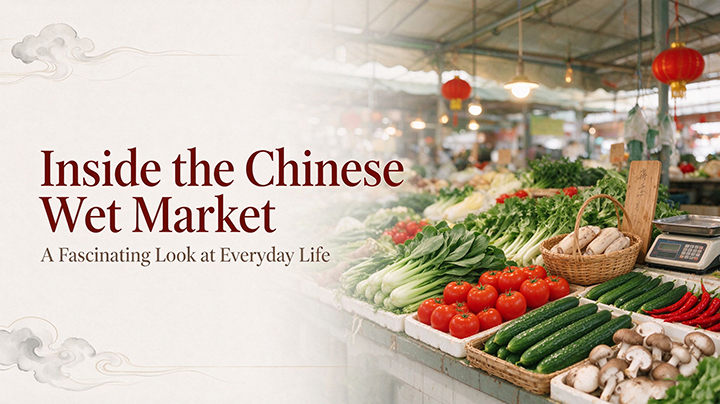
Unlike Western supermarkets where vegetables are wrapped in plastic and meat is hidden behind glass, Chinese wet markets are a sensory explosion.
- The Colors: Pyramids of bright red tomatoes, leafy greens, and exotic fruits.
- The Sounds: Vendors shouting out their daily prices, the splash of live fish in water tanks, and the rhythmic chopping of meat on wooden blocks.
- The Smells: Fresh herbs, spices, and the aroma of hot breakfast foods being cooked right next door.
2. The “Live” Seafood Experience
If you are an expat in China, your first trip to a wet market can be a culture shock. The seafood section is particularly intense.
Instead of frozen fillets, you will find tanks of live fish, swimming crabs, and snapping shrimp. You pick exactly what you want, and the vendor will clean and prepare it for you on the spot.
While this may seem unusual to Western eyes, the Chinese belief is simple: the fresher the food, the better it tastes, and the healthier it is.
(💡 Love fresh seafood? Check out these heavy-duty Chinese chef’s knives on Amazon, perfect for preparing fish and meat at home!)
3. The Ultimate Bargaining Culture
One of the most engaging parts of everyday life in China is the daily interaction at the market.
While modern supermarkets in China have fixed prices, traditional wet markets are a place of friendly negotiation. Locals will chat with the vendors, ask what is fresh today, and occasionally haggle (Tǎo Jià Huán Jià – 讨价还价) for a better price.
If you are a foreigner trying to learn Mandarin, the wet market is the best place to practice. Vendors are usually incredibly warm and patient, often throwing in a free handful of scallions (green onions) if you buy their vegetables.
4. How Technology Has Changed the Market
While the wet market feels ancient, it is actually at the cutting edge of modern Chinese life.
You rarely see cash changing hands anymore. Everyone pays using their smartphones via WeChat Pay or Alipay. Even the 70-year-old grandmother selling homemade tofu will have a QR code hanging on her stall.
Furthermore, during the pandemic and beyond, delivery apps like Meituan and Ele.me integrated wet markets into their systems. If it rains, locals simply order fresh vegetables and raw meat through their phones, and they are delivered right to their doors in 30 minutes.
(💡 Want to cook like a local? Shop the best carbon steel woks for Chinese cooking on Amazon here)
5. The Magic of the “Wok Hei” (Breath of the Wok)
Why do the Chinese care so much about fresh markets? Because the secret to great Chinese food is high heat and fresh ingredients.
If you visit a Chinese friend’s home, you’ll see how the daily fresh ingredients are transformed. A sharp, heavy cleaver (like the Chinese Cai Dao) and a traditional round-bottom wok are the only tools they need. The combination of extreme heat, oil, and fresh vegetables creates a magical flavor that the Chinese call Wok Hei (the “breath of the wok”).
Final Thoughts
The Chinese wet market is more than just a place to buy food; it is a social hub, a cultural classroom, and a sensory adventure. It represents a lifestyle where food is not just fuel, but an art of living.
Whether you are traveling to China, living there as an expat, or just cooking Chinese food at home, taking a stroll through a wet market is an experience you will never forget.
Bring China Into Your Kitchen!
You don’t need to live in China to cook authentic food. With the right tools—like a traditional bamboo steamer, a carbon steel wok, or a Chinese chef’s knife—you can recreate the magic of the wet market right at home. These are widely available on Amazon, making it easier than ever to start your culinary journey today!”
(As an Amazon Associate, we earn from qualifying purchases.)