If you ask any expat living in China what they miss most when they leave the country, the answer is almost always the same: the delivery system.
In many Western countries, ordering food means waiting 45 minutes to an hour, paying high delivery fees, and hoping your fries aren’t cold. Ordering a package online means waiting 3 to 7 business days.
But in China, daily life operates at a completely different speed. Whether it’s a hot bowl of noodles, a fresh iced coffee, or a pair of socks, it can arrive at your door in 30 minutes.
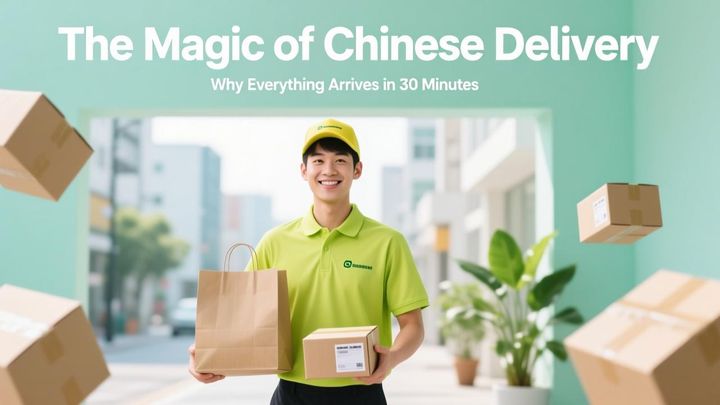
Here is a fascinating look at the magic behind Chinese delivery—and how it has completely transformed everyday life.
1. The Food Delivery Apps: Meituan & Ele.me
The food delivery industry in China is a fierce duopoly between two massive apps: Meituan (美团) and Ele.me (饿了么).
What makes them so magical isn’t just the speed—it’s the sheer variety of what you can order. It’s not just pizza and burgers. You can order:
- A full sit-down meal from a high-end restaurant.
- Freshly brewed bubble tea (with custom ice and sugar levels).
- Raw groceries (vegetables, meat) from the local wet market.
- Medicine from the pharmacy.
- Even a single cup of hot water (yes, really).
The Technology: The apps use incredibly advanced AI algorithms to match your order with the nearest restaurant and the nearest delivery rider (Waimai Qishou). The routing is so precise that riders can navigate through traffic and apartment complexes with military precision.
(💡 Want to know where these fresh groceries come from? Read our guide to the Chinese Wet Market.)
2. The Blue and Yellow Armies
If you walk down any street in China, you will see them: thousands of electric scooters ridden by delivery workers in bright yellow (Meituan) or blue (Ele.me) uniforms.
They are the unsung heroes of Chinese everyday life. These riders are paid based on the number of orders they deliver, creating an incredibly fast-paced work environment. They have a strict 30-minute window for each delivery.
Because of this, they have mastered the art of navigating crowded sidewalks and busy intersections. While this speed is convenient for the consumer, it also creates a high-pressure job. During heavy rain or extreme heat, consumers usually leave a “tip” (Da Shang – 打赏) via the app to show their appreciation.
3. The E-commerce Miracle: Taobao, JD, and Pinduoduo
Food isn’t the only thing that arrives fast. China is home to the largest e-commerce market in the world, dominated by platforms like Taobao, JD.com, and Pinduoduo.
- Same-Day Delivery: If you order on JD.com before 11:00 AM, there is a very high chance you will receive your package that same afternoon. They achieve this by storing goods in local warehouses based on AI predictions of what people will buy.
- The Parcel Locker (Cainiao / Fengchao): You rarely wait at home for a package. Your delivery driver will drop it into a smart parcel locker or a local package station (Yizhan) in your apartment complex. You get a QR code on your phone, scan it, and pick up your package at your convenience.
(💡 Check out our guide to using Alipay for online shopping on Amazon here)
4. The “Run Errands” Culture (Paotui)
Beyond just food and packages, China has a unique gig economy for “running errands” known as Paotui (跑腿).
If you forgot your keys at a friend’s house across the city, you can pay someone on an app to ride a scooter across town, pick up the keys, and deliver them to you. Need someone to stand in line at a popular restaurant to save you a table? A Paotui rider will do that too. If you are willing to pay a small fee, there is almost nothing they won’t deliver.
5. How to Use These Apps as a Foreigner
For tourists and expats, tapping into this delivery magic is easier than ever.
- Language: Meituan and Ele.me don’t have fully localized English versions yet, but you can use the translation feature on your phone’s camera to navigate the menus.
- Payment: You can link your international Visa/Mastercard to Alipay, which is integrated with most delivery apps.
- Address: Always put your address in Chinese characters, and include landmarks (e.g., “Next to the Starbucks”). Riders call you when they arrive, so having basic Mandarin phrases on hand helps.
Final Thoughts
The Chinese delivery system is a marvel of modern logistics and technology. It represents a lifestyle where convenience is paramount and speed is the ultimate currency.
While the high-pressure gig economy has its challenges, for the average consumer, it means everyday life is incredibly smooth. So, the next time you visit or live in China, embrace the magic—order a late-night bowl of noodles, and watch the yellow and blue army bring it to your door in 29 minutes.